
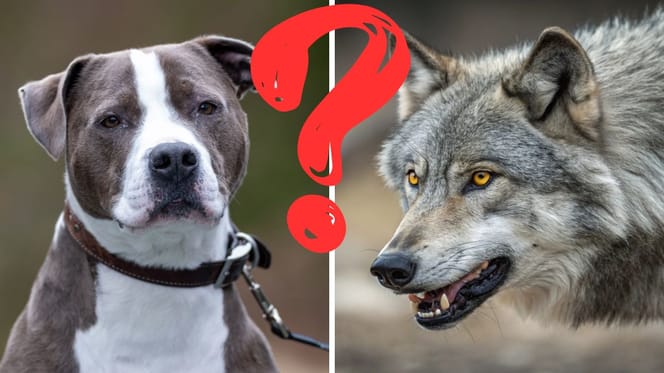

Colorado, United States: Those who live with their dog near the famous Yellowstone National Park would be wise to have them neutered. That's what the owners of a Pitbull learnt the hard way when their home sat right on the edge of the forest.
When the dog came into heat, something unexpected happened. A wild grey wolf from the national park, drawn by her scent, did what nature dictates. A few weeks later, the dog gave birth to eight puppies – half wolf, half Pitbull.

"Pitwolves": eight puppies like no other
According to DNA tests, these puppies have a fascinating genetic mix. They're 50% grey wolf, 45% American Pitbull Terrier and 5% Chesapeake Bay Retriever.
"They look more like dogs, but in their eyes, you see the wolf," explain the team at Pack 22 Alpha rescue station in Colorado on Instagram. The post quickly went viral, fascinating countless internet users with the uniqueness of these hybrids.
These crossbreeds are called "Pitwolf hybrids". A name that perfectly describes what they are: half wild predator, half loyal companion. But which half dominates?
The tragic fate of the wolf father
The father of the little "Pitwolves" was put down shortly after the unusual mating. The reason: he had killed livestock in the area. For farmers, it was an existential threat; for the authorities, an unavoidable decision.

Raised between two worlds
The eight puppies were initially taken in by a wolf rescue station in Montana before being transferred to Pack 22 Alpha. They've lived there for two years now, surrounded by more than 110 other wolves and hybrids.
The animal carers offer them a life close to freedom. "They can be themselves – howl or bark, as they naturally feel," the carers explain on Instagram.
A wolf hybrid isn't to be adopted like a dog
Falling for the "Pitwolves" isn't enough to adopt one. In many regions of the United States, keeping wolf hybrids is strictly regulated.
"Before one of these animals joins a home, you need to check if it's legal," the organisation points out. So far, only two of the eight puppies have found a suitable family. The others are still waiting for a home capable of managing the specific needs of hybrids.
Translated from the DE Wamiz website using artificial intelligence

