
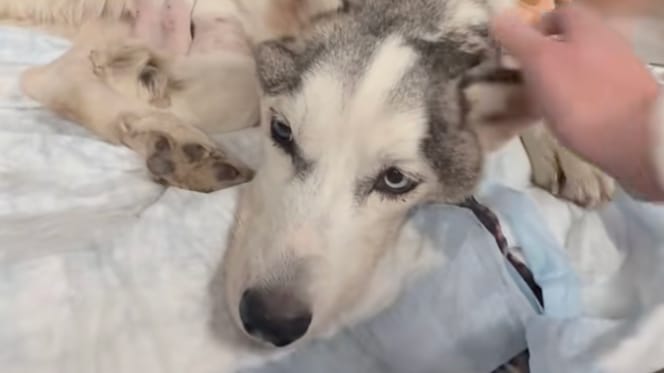
When Megan Tate saw a photo of Wolf on social media, she knew instantly that something was wrong. The Husky had been found wandering the streets, reported by a local resident who regularly feeds stray dogs in the area. He weighed only 19 pounds. After being taken in by a local shelter, he quickly became a cause for concern among vets, to the point where euthanasia was mentioned several times.
But for the Miami-based rescuer and founder of SGT Canines, giving up was not an option. "I don't believe in it, especially without a confirmed diagnosis," she told Newsweek, referring to euthanasia. She explained that the word itself is now a source of real trauma for her, having heard it so many times over the years.


A critical condition... but no clear diagnosis
Megan Tate immediately contacted the shelter and offered to take Wolf in, regardless of his condition. She soon realised the situation was even more serious than she had thought. During the initial examinations, vets described his case as "very interesting", but they were unable to make a precise diagnosis.
Ultrasounds, X-rays, and emergency tests all came back largely inconclusive. Wolf was stable, and nothing seemed to pose an immediate threat to his life. However, one clear abnormality stood out: a severe thickening of the stomach wall in the lower digestive tract. The vets suggested it could be gastrointestinal lymphoma or terminal cancer.
Megan Tate wasn't convinced. Having lost a dog herself to an aggressive lymphoma, she felt that Wolf's condition didn't match her previous experience. Another theory was put forward: extreme starvation combined with a digestive disease preventing nutrient absorption. Despite this, euthanasia was recommended once again. It was an option she refused to consider.
Wolf was put on a strict, low-fat diet with a very gradual refeeding plan. He was also given IV fluids. His condition fluctuated, but his blood tests showed steady improvement. The vets then suggested continuing his care for six weeks to definitively rule out an incurable disease.
A relentless fight for answers
Three weeks later, just as Wolf was starting to slowly regain some weight, he suddenly collapsed. Megan Tate rushed him to the veterinary hospital. A new round of comprehensive tests was carried out, including a CT scan. For several days, no clear answers emerged. The scan revealed a very localised thickening of the stomach wall, with no widespread involvement. Once again, the vets described it as an "unusual" case.
By this point, the rescuer had already spent several thousand dollars. Emotionally exhausted and facing the decisions almost entirely on her own, she chose to carry on. "I decided to listen to him," she explained. Throughout his hospital stay, Wolf remained alert and stable. She visited him every day, grew attached to him, and trusted what she saw more than the prognoses.
While seeking help on social media and continuing her own research, Megan Tate came across pythiosis, a rare and often fatal fungal-like infection transmitted through contaminated water. Shortly after, a veterinary professional contacted her and suggested testing Wolf for the disease. The next day, the diagnosis was confirmed: Wolf was suffering from a severe Pythium infection.
The vets told her that the disease is usually fatal. Once again, euthanasia was suggested. Megan Tate refused and opted for surgery, despite the risks. The vets explained that most dogs with pythiosis only survive for about 26 days. Wolf had already surpassed that timeframe.
The operation, which was expensive and had no guarantee of success, lasted over six hours. Thanks to the community's support, the necessary funds were raised. The surgeons managed to remove all the infected tissue with clean margins, an extremely rare outcome in such cases.
Against all odds, Wolf survived. Eight weeks later, he was officially declared free of Pythium, stunning the entire veterinary team. In total, his care cost nearly $40,000, all of which was covered by donations. Meanwhile, the vets discovered a microchip. His former owners were contacted. They had reported the dog, then named Ghost, missing more than a year earlier. They had since moved and started a new life, and did not want him back.
Today, Wolf is continuing his recovery and making progress every day. He is safe with his foster family, who already own Huskies and have made his wellbeing their top priority. "If they didn't adopt him, I would 100% keep him in my family. But I'm hopeful, I really believe they intend to adopt him," Megan Tate concluded.
Translated from the Wamiz website FR using artificial intelligence

