
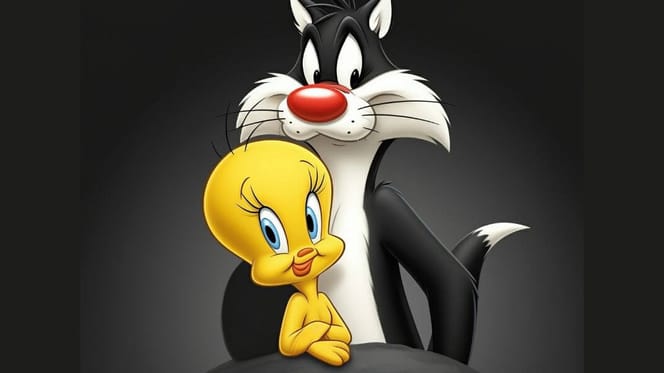

From theatrical shorts to later television productions, their cat and bird chase has entertained generations with clever escapes, comic timing and plenty of slapstick.
Sylvester wants to catch Tweety, while the seemingly innocent yellow canary repeatedly finds ways to turn the tables. Their contrasting personalities and memorable supporting characters have helped keep them part of popular animation culture for decades.
Who are Sylvester and Tweety?
Sylvester the Cat and Tweety Bird are characters from the Warner Bros. cartoon universe, closely associated with Looney Tunes and Merrie Melodies. They developed separately before becoming one of animation's best-known rivalries.
Sylvester first appeared in 1945 in Life with Feathers, directed by Friz Freleng. Tweety appeared earlier, in 1944's A Tale of Two Kitties, created by Bob Clampett. Tweety was originally depicted with pink skin rather than the familiar yellow feathers that became his trademark.
Their paths eventually crossed in a series of shorts where Sylvester's attempts to catch Tweety became the central joke. The straightforward premise gave writers and animators plenty of opportunities to create new situations and gags.
What is Sylvester's relationship to Tweety?
Sylvester sees Tweety primarily as prey, and much of their comedy comes from his repeated attempts to catch the canary. Tweety, meanwhile, is usually protected by circumstances, other characters or his own quick thinking.
Their relationship is therefore less a friendship than a comic rivalry built around a predator-and-prey dynamic. Sylvester is persistent and inventive, but his plans frequently fail because Tweety is more resourceful than he expects.
That imbalance is central to the humour. Viewers may know that Sylvester is unlikely to succeed, but the fun lies in seeing exactly how his latest scheme will unravel.
Sylvester the persistent pursuer
Sylvester is not simply a villain. He is often frustrated, overconfident and determined, with his failures becoming the source of much of the comedy.
His distinctive lisp, expressive face and exaggerated reactions make him instantly recognisable. Even when he devises an elaborate trap or disguise, impatience and overconfidence often work against him.
Tweety's cleverness
Tweety's innocent appearance contrasts with his ability to think his way out of trouble. His outsmarting/cleverness is central to many stories, demonstrating that physical size does not necessarily determine who has the advantage.
Rather than simply waiting to be rescued, Tweety frequently contributes to his own escape, making him an active participant in the rivalry.
Was Tweety a boy or a girl?
Tweety is generally portrayed as male. Although his cute appearance and high-pitched voice can lead viewers to assume otherwise, the character has consistently been treated as a male canary.
The confusion is understandable, particularly because Tweety's appearance has remained deliberately cute and youthful throughout his history.
Which came first, Tom and Jerry or Sylvester and Tweety?
Tom and Jerry came first. The cat and mouse duo made their screen debut in 1940 in Puss Gets the Boot, created by William Hanna and Joseph Barbera for MGM.
Tweety appeared in 1944 and Sylvester in 1945, meaning both characters followed Tom and Jerry's debut. Sylvester and Tweety subsequently developed their own distinctive form of cat-and-bird comedy.
While both pairings involve a determined predator pursuing a smaller animal, their stories differ. Sylvester's adventures often feature human characters and other animals who influence the outcome.
How did the classic Sylvester and Tweety cartoons work?
The best-known stories usually begin with a simple premise: Sylvester wants to catch Tweety, and something prevents him from succeeding.
The 1940s-1960s cartoons are particularly notable for visual comedy. Elaborate traps, sudden reversals, exaggerated reactions and carefully timed sound effects communicated much of the story without requiring lengthy dialogue.
This was one of the strengths of the theatrical short. Familiar situations could be transformed through movement and timing, while Sylvester's increasingly complicated plans provided opportunities for slapstick humour.
The Granny character and Hector the Bulldog
The supporting cast also helped keep the stories varied. The Granny character became an important part of the cartoons, usually acting as Tweety's protective owner and making Sylvester's attempts considerably more difficult.
Hector the Bulldog also became a recurring character. His presence often gave Tweety additional protection while creating another obstacle for Sylvester.
These characters expanded the basic rivalry without changing the central premise.
The Sylvester & Tweety Mysteries
The characters were given a new format in The Sylvester & Tweety Mysteries, an animated television series that ran from 1995 to 2002.
Rather than simply repeating the traditional cat and bird chase, the series placed Sylvester, Tweety, Granny and Hector in mystery stories. They travelled to different locations and investigated unusual cases, allowing their familiar personalities to work within a broader format.
The series retained the tension between Sylvester's desire to catch Tweety and Tweety's ability to escape, but the mystery plots gave the characters new situations to explore.
It also introduced the familiar characters to viewers who had grown up after the original theatrical shorts.
Why does the Sylvester and Tweety rivalry still work?
The appeal of the rivalry is partly its simplicity. There is no complicated backstory that viewers need to remember. Sylvester wants something, Tweety wants to avoid him, and the story develops from that conflict.
Yet the formula leaves plenty of room for creativity. Writers can change the setting, introduce new obstacles or give Sylvester another elaborate plan without losing what makes the characters recognisable.
The rivalry also plays with expectations. Sylvester may be physically larger, but Tweety's cleverness regularly gives him the advantage.
From classic cartoons to generations of fans
Sylvester and Tweety have survived far beyond the era of their original theatrical shorts. Television broadcasts, compilation episodes, home media and later productions have repeatedly introduced their adventures to new audiences.
Their continued recognition is also part of the wider legacy of Warner Bros. animation. Alongside other familiar Looney Tunes and Merrie Melodies characters, they demonstrate how a simple premise and strong personalities can endure across generations.
Why Sylvester and Tweety remain cartoon favourites
Few animated rivalries need as little explanation as Sylvester and Tweety. A determined cat, a deceptively clever canary and an endless supply of increasingly elaborate schemes are enough to create stories audiences can immediately understand.
From the original shorts to The Sylvester & Tweety Mysteries, their adventures have changed with the times while preserving the relationship that made them famous.
The animation and formats may change, but the pleasure of watching Sylvester devise yet another plan, only for Tweety to find a way out, remains at the heart of this enduring piece of cartoon history.


