
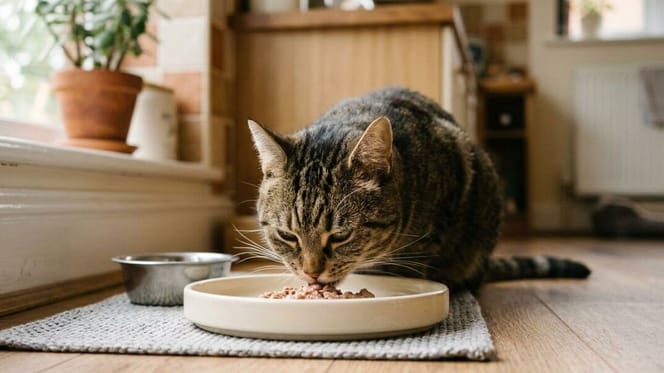

Although the term whisker fatigue is talked about in terms of feline care, there is limited scientific evidence to establish it as a distinct medical condition. Understanding your cat’s behaviour can help you make mealtimes more comfortable.
Whiskers play an important role in how cats explore their surroundings. While evidence linking ordinary bowl contact to whisker fatigue remains limited, small changes to your cat’s feeding arrangements may be worth trying.
What is whisker fatigue?
Whiskers, also known as vibrissae, are specialised hairs rooted deep in the skin and connected to sensory receptors. They help cats detect nearby objects, sense subtle movements and navigate their surroundings.

Whisker fatigue, sometimes called whisker stress, describes the theory that repeated contact with objects may overstimulate these sensory structures and cause discomfort. Food and water bowls are often suggested as possible triggers, particularly when their sides repeatedly brush against a cat’s whiskers.
However, there is insufficient scientific evidence to confirm whisker fatigue as a distinct veterinary condition. Although whiskers are highly sensitive, it remains uncertain whether routine contact with bowl edges causes the symptoms commonly attributed to it.
Whisker fatigue symptoms and possible causes
The proposed causes of whisker fatigue centre on interference with whiskers during everyday activities. However, changes in eating behaviour can have several explanations, so it is important not to assume that whisker contact is responsible.
What signs should you look for?
Possible signs associated with suspected whisker stress include:
- Removing food: taking pieces out of the bowl and eating them elsewhere
- Hesitating at mealtimes: approaching a dish but appearing reluctant to eat
- Pawing at food: moving food around or scooping it out of the bowl
- Avoiding deep bowls: appearing more comfortable eating from a plate
- Changing eating habits: becoming unsettled or eating less than usual
These behaviours do not prove whisker fatigue. Food preferences, an uncomfortable feeding position, dental pain and other medical problems can cause similar changes.
Stress in cats may also result from noise, competition with other pets or an unsuitable feeding location. Consider the wider environment rather than focusing on the bowl alone.
Can a whisker fatigue bowl help?
Specialist whisker-friendly bowls are designed to reduce contact between a dish and a cat’s whiskers. Although their effectiveness in preventing whisker fatigue has not been firmly established, trying a different bowl is a straightforward way to explore your cat’s preferences.
Choose wide, shallow bowls
Wide, shallow bowls or flat plates give cats more room to reach their food without pushing their faces into narrow spaces. Choose a dish that allows your cat to eat comfortably without needing to squeeze between high sides.
A suitable bowl may be particularly helpful if your cat consistently avoids a particular dish. Observe whether changing it makes a difference rather than assuming the new design will solve the problem.
Consider the material and height
Ceramic, glass and stainless steel are practical choices because they are generally easy to clean. Plastic bowls can develop scratches that make thorough cleaning more difficult over time.
Raised bowls are sometimes recommended for suspected whisker fatigue, but elevating a dish does not necessarily prevent whisker contact. There is also insufficient evidence that raised bowls treat the condition. Choose a stable bowl at a height that suits your cat.
Whisker fatigue treatment: Practical ways to help
There is no established medical treatment for whisker fatigue because it has not been confirmed as a distinct veterinary condition. However, a few straightforward adjustments may improve your cat’s feeding experience.
- Try a different dish: replace a narrow, deep bowl with a wider, shallower alternative and observe your cat’s response
- Keep meals familiar: continue offering your cat’s usual food and feeding routine while testing a new bowl
- Create a quiet feeding area: position food and water away from noisy appliances, busy walkways and competing pets
- Provide separate resources: in multi-cat households, offer individual feeding spaces to reduce competition and allow cats to eat undisturbed
- Maintain good hygiene: wash bowls regularly, remove leftover food and provide fresh drinking water
These measures are practical ways to investigate possible discomfort, rather than proven whisker fatigue treatment. Never trim your cat’s whiskers, as they are important sensory structures that help them interpret their surroundings.
Could another health problem be responsible?
Changes in eating and drinking should not automatically be attributed to whisker fatigue. Dental disease, mouth ulcers, nausea and other health conditions can make eating uncomfortable or reduce appetite.
If your cat persistently avoids food, loses weight or appears uncomfortable when chewing, contact your vet. Seek prompt veterinary advice if your cat stops eating, particularly if they seem unwell. Do not delay care while experimenting with different bowls.
A veterinary examination can help identify the cause and determine whether treatment is needed.
Make mealtimes happier for your cat
Every cat has individual preferences, and a simple change of bowl may make eating more comfortable. Wide, shallow dishes, clean feeding equipment and a peaceful eating area are sensible options to try if your cat seems reluctant to use its usual bowl.
Although whisker fatigue has not been established as a distinct medical condition, changes in your cat’s behaviour around mealtimes are still worth paying attention to. By observing changes, adapting the feeding environment and seeking veterinary advice when necessary, you can support your cat’s wellbeing without overlooking a potential health problem.


