
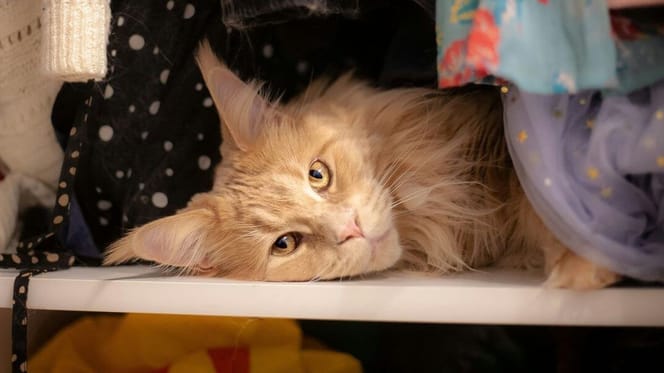

Whether your cat likes curling up between your clothes or squeezing into a cupboard whenever the door opens, you're probably familiar with their fascination with enclosed spaces.
From seeking safety and comfort to enjoying familiar smells and a cosy place to nap, there are several reasons why wardrobes make such appealing hiding places. Understanding this behaviour can offer an insight into your cat's natural instincts and individual preferences.
Why do cats like closets?
Cats are naturally drawn to enclosed, small and dark spaces. As both predators and potential prey, their ancestors relied on sheltered places to rest, observe their surroundings and avoid potential dangers. A wardrobe offers a similar environment, allowing a cat to feel protected while remaining aware of what is happening nearby.

This preference for small, tight spaces where they feel surrounded is also why cats enjoy boxes, baskets and hiding under furniture. Being enclosed can provide a sense of security, while having a small entrance gives them some control over who or what can approach.
For many cats, a wardrobe is simply an appealing combination of privacy, comfort and somewhere peaceful to retreat.
Hiding provides a sense of safety and security
Seeking safety and security is one of the main reasons cats enjoy hiding. Even confident, sociable cats need somewhere they can withdraw when the household becomes noisy or overwhelming.
A wardrobe can provide an ideal hiding place during thunderstorms, visits from strangers or changes to their usual routine. Being tucked behind hanging clothes or inside a quiet cupboard allows them to feel less exposed.
This behaviour is generally normal, provided your cat also spends time interacting with family members, eating, drinking and behaving as usual.
Cats may also enjoy hiding under blankets for similar reasons. The feeling of being surrounded can be reassuring, although it is important to make sure they can breathe comfortably and move away whenever they want.
Familiar smells and soft fabrics make closets comfortable
Another reason for a cat's fascination with wardrobes is the combination of familiar scents and inviting textures.
Cats have a highly developed sense of smell and use scent to understand their surroundings. The smell of their owner's clothes can be particularly appealing, providing reassurance through a familiar scent associated with safety and companionship.
Soft jumpers, towels and blankets also make comfortable places to curl up. Cats often seek out warm, padded surfaces for sleeping and napping, and a pile of freshly washed laundry can be just as attractive as an expensive cat bed. Having soft fabric to cuddle into makes a wardrobe even more inviting.
Some cats also knead clothing before settling down. This instinctive behaviour, which begins during kittenhood, is commonly associated with comfort and relaxation.
Curiosity and the obsession with getting inside
Cats are naturally inquisitive, so a closed wardrobe door can be an irresistible invitation to investigate.
Their fascination with entry may become particularly obvious when they hear the door opening or notice something being moved inside. They might squeeze through the smallest gap, paw at the door or wait patiently for an opportunity to explore.
Closets offer plenty of interesting things to inspect, from unfamiliar objects and shoes to changing smells and different textures. Even a familiar wardrobe can provide new discoveries, particularly when its contents are rearranged.
This inspecting and exploring behaviour is part of normal feline curiosity. Sometimes, the attraction is less about what is inside and more about the satisfaction of gaining access to somewhere that was previously off limits.
Territorial behaviour and ownership
Cats are territorial animals and often regard favourite resting places as part of their personal domain.
A wardrobe can become an established part of this territory, particularly if it offers reliable access to quiet and comfortable surroundings. Your cat may repeatedly return to the same shelf, corner or laundry basket because it has become a familiar and preferred spot.
Cats also use scent to communicate ownership. Glands around their cheeks and forehead release pheromones when they rub against objects, leaving familiar scent signals behind.
This behaviour helps create a reassuring environment and can be particularly important in multi-cat households, where individual animals may prefer having separate places to retreat.
Why do cats like closets at night?
Cats are naturally more active around dawn and dusk, although their routines vary considerably. At night, when the household becomes quieter, a wardrobe may provide an especially appealing place to settle.
The enclosed surroundings, reduced noise and familiar smells can make it an ideal sleeping spot. Some cats also prefer dark places to sleep because they offer fewer visual distractions and a greater sense of privacy.
However, not every cat wants to sleep in a wardrobe. Others prefer a sunny windowsill, a favourite sofa or the comfort of their owner's bed.
Is it normal for cats to hide in closets?
Yes. Hiding is a normal feline behaviour, and choosing a wardrobe for a nap or a little peace and quiet is usually nothing to worry about.
However, if your cat suddenly starts spending much more time hiding, it is worth paying attention. A change in behaviour can sometimes indicate stress, anxiety, pain or an underlying health problem.
If your cat is sleeping in the wardrobe all of a sudden, consider whether anything has changed at home. New pets, visitors, building work or changes to their environment could be contributing factors.
If hiding is accompanied by changes in appetite, drinking, toileting, grooming or activity levels, contact your vet for advice. Cats can be very good at concealing signs of illness, so unexplained behavioural changes should not be dismissed.
Making your cat's favourite hiding place safe
If your cat loves spending time in the wardrobe, there is no need to discourage the behaviour, provided the space is safe.
A few simple precautions can help:
- Keep cleaning products, medicines, mothballs and other potentially harmful substances securely stored away
- Remove sharp objects, loose wires and anything that could fall or trap your cat
- Make sure there is adequate ventilation and enough room for your cat to turn around and leave comfortably
- Check the wardrobe before closing the door to avoid accidentally shutting your cat inside
- Consider providing a soft blanket or cat bed in an accessible corner
If you would prefer your cat to use another hiding place, offer an alternative such as a covered cat bed, cardboard box or cosy blanket in a quiet part of the house.
Let sleeping cats lie
A cat's love of wardrobes is usually a perfectly natural expression of its instincts. Whether it is seeking safety, enjoying familiar smells, exploring somewhere new or simply looking for a comfortable place to sleep, an enclosed space can meet several feline needs at once.
As long as your cat has a safe environment and is otherwise behaving normally, there is little reason to worry about this curious habit. Sometimes, the perfect retreat is not an expensive cat bed but a quiet corner of your wardrobe.


