
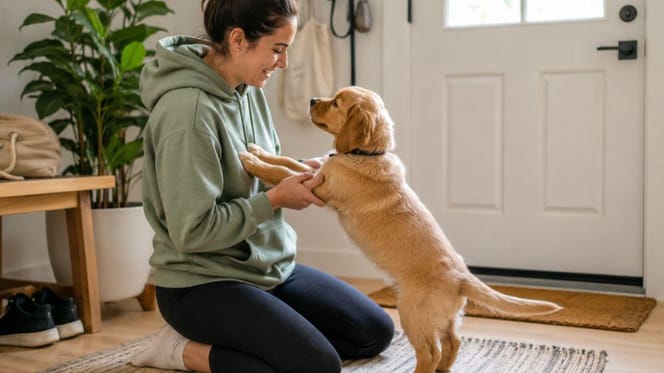

A puppy bouncing up to greet you can be adorable, but it soon becomes a problem if the habit continues as they grow. Jumping up can knock over children, overwhelm visitors and make everyday greetings stressful. Fortunately, it's a behaviour that's usually straightforward to change.
With patience, positive reinforcement, and training consistency, you can teach your puppy that keeping all four paws on the floor is far more rewarding than jumping. If you've recently welcomed a puppy home, the Zigzag puppy training app can also provide personalised guidance and daily training exercises to support you through every stage of their development.
How to train your puppy not to jump up
The key to success is showing your puppy what you want them to do instead of simply telling them what not to do. Every interaction is an opportunity to reinforce calm, polite behaviour.

Why do puppies jump up?
Puppies naturally jump because they're excited and looking for attention. They also greet other dogs face-to-face, so trying to reach your face is instinctive.
Sometimes, owners accidentally encourage the behaviour. Talking to a jumping puppy, laughing, pushing them away or even telling them "no" can still be rewarding because they're receiving attention.
Teaching your puppy that calm behaviour earns rewards is much more effective than punishment.
Reward calm behaviour every time
One of the most important parts of puppy training is rewarding calm behaviour.
Whenever your puppy has all four paws on the floor, quietly praise them and offer affection or use treats as rewards. The reward should come immediately so your puppy understands exactly which behaviour earned it.
The more often calm behaviour is rewarded, the more likely your puppy is to repeat it.
Ignore the jumping
One of the quickest ways to reduce jumping is to ignore the jumping altogether.
If your puppy jumps up:
- turn your body away
- avoid eye contact or touching when jumping
- stay quiet until they settle
As soon as all four paws return to the floor, calmly greet and reward them.
This teaches your puppy that jumping makes attention disappear, while calm greetings bring all the good things.
Teach an alternative behaviour
Rather than focusing on stopping the jumping, spend time teaching alternate behaviours (like sit).
Before greeting your puppy or opening the front door, ask them to sit. Once they do, reward them with praise or a treat before saying hello.
Over time, sitting becomes their natural way of greeting people.
As your puppy becomes more confident, you can begin teaching on cue, so they automatically offer a sit whenever someone approaches.
Use simple commands
Some owners also like using commands (like "off") once the behaviour is understood.
If your puppy jumps, calmly say "off", wait for them to return to the floor, then reward the correct behaviour. Keep your tone calm and avoid repeating the cue unnecessarily.
Manage the environment
Alongside training, managing the environment helps prevent your puppy from practising unwanted behaviours.
If visitors are coming around, reduce excitement before they reach the door.
Use baby gates and leads
Using barriers (baby gates) can help create space while your puppy learns to stay calm around guests. A lead can also help guide them into position without pulling or scolding.
Ask friends and family to wait until your puppy is calm before giving them attention. Consistency from everyone makes a huge difference.
How to stop a dog from jumping up on strangers
Many puppies behave well at home but become overexcited when meeting new people.
If your dog jumps up at strangers on walks, ask for a sit before allowing anyone to greet them. Reward calm behaviour first, then let the greeting happen.
If your puppy jumps, politely end the interaction and try again once they've settled.
Practising calm greetings in different places helps your puppy understand that the same rules apply wherever they are.
How to stop your dog jumping up when you get home
Many owners wonder how to stop a dog from jumping on you when excited at home.
The easiest solution is to keep arrivals low-key. Walk in calmly, avoid exciting greetings and wait until your puppy has settled before giving them attention.
This teaches them that calm behaviour, not frantic excitement, earns your affection.
How to stop a puppy from jumping up and biting
Excited puppies sometimes combine jumping with mouthing.
If you're wondering how to stop a puppy from jumping up and biting, avoid rough games that encourage grabbing at hands or clothing. Instead, begin redirecting behaviour onto an appropriate toy and reward your puppy as soon as they calm down.
If they become overexcited, pause the interaction briefly before trying again.
Do puppies grow out of jumping up?
Not usually. Although many dogs become calmer as they mature, jumping often continues if it's been rewarded throughout puppyhood. Early training is the best way of preventing nuisance behaviours before they become lifelong habits.
At what age do dogs stop jumping up?
There's no set age.
Some puppies become calmer after adolescence, while energetic breeds may stay bouncy for longer. Regular practice and training consistency are far more important than waiting for your puppy to grow out of the behaviour.
Should you use a device to stop a dog jumping?
You may see products advertised as a device to stop a dog from jumping, but most puppies don't need them.
Reward-based training, clear routines and good management are usually all that's required. These methods help build confidence and trust while producing reliable, long-term results.
Keep your puppy engaged
Daily enrichment activities and games can also reduce overexcited behaviour.
Puzzle feeders, scent games, short training sessions and interactive toys all provide valuable mental stimulation. A puppy whose physical and mental needs are being met is often much better able to focus during greetings.
If you'd like extra support, Zigzag offers age-specific training plans and expert advice to help you teach polite greetings and many other essential life skills.
When should you seek extra help?
Most puppies respond well to consistent, reward-based and positive reinforcement training. However, if jumping is accompanied by aggression, fear or other worrying behaviours, it's worth speaking to a qualified dog trainer or behaviourist who can provide tailored advice.
Build polite greetings for life
Learning how to train your puppy not to jump up takes patience, but the results are well worth the effort. By combining positive reinforcement, rewarding calm behaviour, using treats as rewards, managing the environment, greeting politely and tips and advice from the Zigzag app, you'll help your puppy develop good manners that last a lifetime.
With consistency, encouragement and plenty of practice, your puppy will soon learn that keeping four paws on the floor is the quickest route to attention, praise and rewards.


