
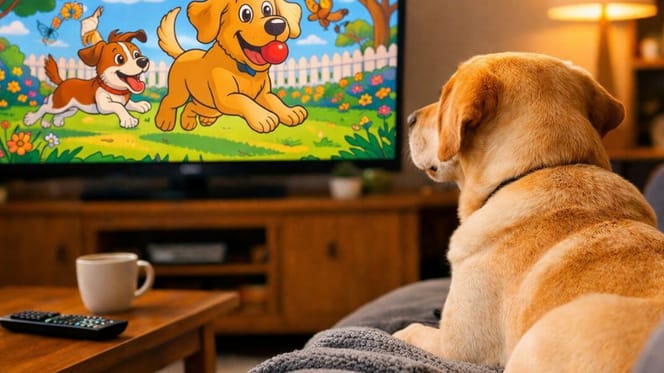

Many owners have noticed their dog reacting to animals on screen or turning towards certain sounds. While it might look like simple curiosity, there is more going on beneath the surface. Dogs can watch TV, but how they experience it is shaped by their senses, instincts and individual personality.
Understanding how dogs see and interpret images on TV helps explain why some are fascinated and others are not.
How do dogs perceive television?
Dogs do not experience television in quite the same way we do. Their senses prioritise different things, which affects how engaging a screen appears.

Dogs’ vision differs from humans
One of the biggest factors is that dogs' vision differs from humans. Dogs see a narrower range of colours, mainly blues and yellows, while reds and greens appear muted or similar. This means some scenes that look vivid to us may appear less striking to them.
However, dogs are far more sensitive to movement. Their eyes are designed to detect motion quickly, which is why movement and visuals attract dogs so strongly. Fast-moving objects, such as animals running or toys bouncing, are much more likely to grab their attention than static images.
Dogs’ brains process TV differently too. Rather than following a storyline, they respond to individual stimuli such as motion, sound or familiar shapes.
Newer TV technology affects dogs’ ability to watch
Older televisions often appeared as flickering images to dogs, making them harder to engage with. This is because dogs can detect flicker at higher rates than humans.
Newer TV technology affects dogs' ability to watch in a positive way. Modern high definition screens have higher refresh rates and smoother motion, allowing dogs to see and interpret images on TV more clearly. This is one reason more owners now notice their dogs watching television compared to the past.
What captures a dog’s attention on TV?
Not all content is equal when it comes to canine viewers. Certain elements are far more likely to spark interest.
Movement and sound are key triggers
Movement is one of the strongest factors shaping dogs' TV viewing habits. Quick movements, especially those resembling prey such as birds or squirrels, can trigger instinctive responses.
Sounds and noises on TV affect dogs just as much. Barking, whining, doorbells or sudden noises can prompt a reaction, even if the dog cannot see what caused it. These familiar cues can make television feel more real to them.
Because of this, dogs may enjoy or be entertained by TV when it includes a mix of action and recognisable sounds.
What do dogs like to watch on TV?
When it comes to what dogs like to watch on TV, their preferences vary, just like with us. Certain types of content tend to hold attention better:
- Programmes featuring animals, especially dogs or wildlife
- Fast-moving visuals or action scenes
- High contrast colours (particularly blues and yellows)
- Sounds that mimic real-life triggers
Some owners even report their dogs reacting to animated shows, while some may respond to the movement and voices others show little interest. It comes down to individual differences in dogs' interest or reaction.
Why do some dogs watch TV and others do not?
Not all dogs are interested in TV, and that is completely normal. Dogs' attention to TV varies widely depending on several factors.
Breed and personality influence TV watching
Breed and personality influence TV watching more than many people realise. Dogs bred for chasing or herding, such as Border Collies or Terriers, may be more responsive to movement on screen.
More relaxed breeds or older dogs may be less interested. Personality also plays a role. Curious or highly alert dogs are more likely to engage, while calmer dogs may simply ignore it.
These differences in individual dogs' interest or reaction explain why one dog may bark at the TV while another sleeps through it.
Early experiences and environment
Early exposure can also shape behaviour. Dogs raised in busy households with regular background noise may be more accustomed to television.
This links to broader factors shaping dogs' TV viewing habits, including routine, environment and past experiences.
Can TV be useful for dogs?
Television is not essential for dogs, but in some cases it can offer benefits.
Some dogs use TV as enrichment or stimulation
For certain dogs, especially those left alone for periods, TV can act as enrichment or stimulation. Visual and auditory input may help reduce boredom or mild anxiety.
Some streaming platforms even offer dog-specific content designed to appeal to canine senses. While results vary, some dogs use TV as enrichment or stimulation when used alongside other activities.
Do dogs like to watch TV when alone?
Some dogs appear calmer when a TV is left on, particularly if they are used to it. However, not all dogs respond this way. For some, silence may be more relaxing.
Do dogs prefer quiet or TV on?
There is no universal answer. Some dogs find background noise comforting, while others prefer a quiet environment.
Observing your dog’s behaviour is key. If they seem relaxed and settled, either option can work.
Do intelligent dogs watch TV more?
There is no clear evidence that more intelligent dogs watch TV more often. However, highly alert or easily stimulated dogs may show greater interest simply because they respond more quickly to movement and sound.
Should dogs watch TV?
TV can be a harmless addition to a dog’s routine, but it should not replace real-world interaction.
Dogs still need exercise, play, training and social contact. Too much screen time may lead to frustration, especially if they cannot interact with what they see.
As research and scientific studies on dogs watching TV suggest, dogs can recognise animals and respond to them, but their engagement is usually short-lived.
Do dogs watch TV?
The answer is yes, but not in the same way humans do. Dogs can watch TV when movement, sound and familiar cues capture their attention, but not all dogs are interested.
Dogs see and interpret images on TV differently, and their level of engagement depends on factors such as breed, personality and past experiences. While TV can provide occasional enrichment, it works best as a small part of a balanced routine.


