
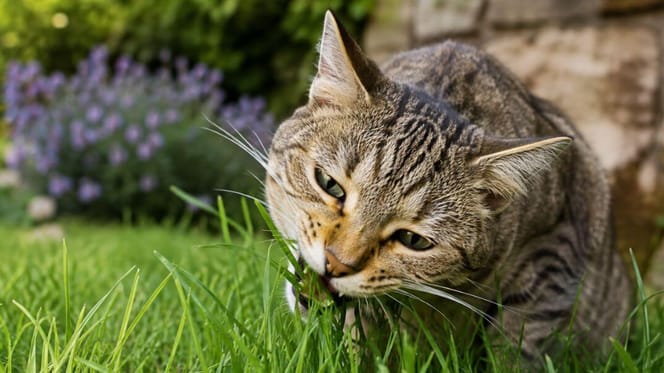

Cats are obligate carnivores, so seeing them chew blades of grass can seem strange. Yet grass eating is common among domestic cats and has also been observed in wild felines.
There is no single proven explanation. Grass may offer fibre, sensory stimulation or satisfy a natural instinct inherited from a cat's ancestors.
Why do cats eat grass?
Scientists have several theories about why cats eat grass. Grass contains fibre and water, so eating small amounts may support gastrointestinal health and provide roughage/fibre.
Its taste and texture may also appeal to a curious cat, making it a normal cat behaviour rather than an automatic sign of illness.
Another explanation is natural instinct/ancestral behaviour. Wild cats sometimes consume plant material, including vegetation present in the digestive tracts of prey. Domestic cats may retain this behaviour even though they eat complete cat food.
Why do cats eat grass if they are carnivores?
Being an obligate carnivore means cats depend on nutrients found in animal-based foods; it does not mean they never eat plants.
Grass may help some cats mimic wild diet patterns, although it is not an essential part of a domestic cat's diet.
Why do cats eat grass and vomit?
It is often said that cats eat grass specifically to make themselves vomit, but there is not enough evidence to say this is the main reason.
Some cats vomit after eating grass and some do not. Grass can irritate the stomach, but this does not mean a cat deliberately ate it to empty its stomach.
Why do cats eat grass if they throw up?
Vomiting may sometimes expel indigestible material, but grass should not be regarded as a reliable way to vomit or expel hairballs. Cats swallow fur during grooming and most passes through the digestive system naturally.
So, is it normal for cats to eat grass and throw up? An occasional episode can happen, but frequent vomiting is not normal and should not simply be blamed on grass.
Does a cat eating grass mean it's sick?
Usually, no. Eating grass alone is not a reliable sign that a cat is ill.
Claims that grass provides relief from upset stomach are not well supported, and eating grass when unwell should not automatically be interpreted as self-medication.
If grass eating suddenly increases alongside repeated vomiting, diarrhoea, lethargy or a change in appetite, contact your vet.
Do cats eat grass when they are sick?
Cats may eat grass when they are sick, but there is no good evidence that they do so to get better. Other changes, such as hiding or eating less, are more important warning signs.
There are also claims that grass provides protection against parasites. Grass is not a recognised treatment for worms or other parasites; appropriate parasite prevention should be discussed with your vet.
Do cats eat grass when hungry?
Hunger is not thought to be a primary reason for eating grass. Grass provides little of the nutrition a cat needs and cannot satisfy hunger like complete cat food.
Why does my cat eat grass when he goes outside?
Outdoor cats have more opportunity to eat grass, so the behaviour may simply be easier to notice. Fresh blades can be appealing because of their scent and texture, while chewing provides sensory enrichment.
The main concern is what else may be on the grass: pesticides, fertilisers, lawn treatments and toxic plants.
Should you let your cat eat grass?
For most healthy cats, occasional access to untreated, cat-safe grass is generally low risk. Cat grass indoors can satisfy this behaviour without exposure to treated lawns.
Wheatgrass, oat grass, barley and rye are commonly grown as cat grass. Choose untreated plants or seeds.
When can grass be dangerous?
Avoid grass from treated areas and prevent access to plants that are poisonous to cats. Long or coarse blades may also cause irritation or become difficult to swallow.
Seek veterinary help promptly if your cat is repeatedly gagging, struggling to swallow or having difficulty breathing.
How do I stop my cat from eating grass?
If your cat occasionally eats a small amount of safe grass, there may be no reason to stop it. If it is eating large quantities or accessing potentially contaminated areas, limit access and offer a safe alternative.
An indoor pot of cat grass can satisfy the urge to chew safely.
Do cats eat grass when pregnant?
Pregnant cats do not have a known need for grass. They need an appropriate complete diet and veterinary care.
If a pregnant cat suddenly eats large amounts of grass or vomits repeatedly, speak to your vet.
Can grass help a cat's digestion?
Grass contains fibre, so small amounts may provide roughage and support normal digestive function. However, it should not be relied on as a digestive aid or treatment.
Claims that grass acts as a natural laxative, provides constipation relief or offers elimination support are not firmly established. Fibre can contribute to gastrointestinal health, but persistent constipation needs veterinary assessment.
Grass should not be used to guarantee regular bowel movements. Persistent constipation needs veterinary advice.
What does grass eating mean for your cat?
For most cats, grass eating is normal cat behaviour rather than a sign that something is wrong. It may provide fibre, sensory enrichment or reflect an ancient instinct, but there is no single explanation for every cat.
Safe, untreated grass can be offered as optional enrichment. It is not a treatment for vomiting, hairballs, constipation or parasites. If grass eating comes with persistent illness or a sudden behavioural change, speak to your vet.


