
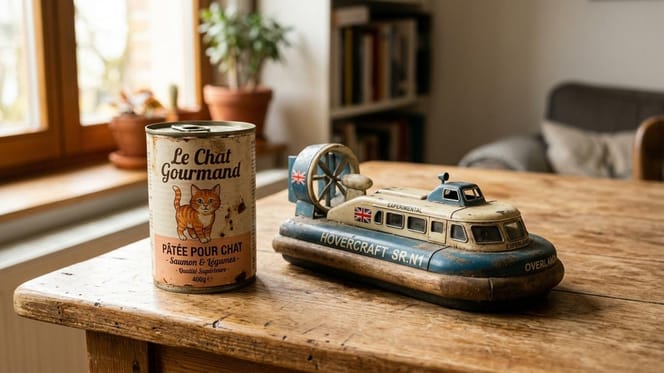


A kitchen table experiment
In 1955, British engineer Christopher Cockerell was looking for a way to help vessels move more efficiently through water. Lacking a state-of-the-art laboratory, the scientist decided to make do with what he had to hand, right on his kitchen table.
He gathered a rather unusual set of items: a coffee tin, an air blower, a pair of kitchen scales, and an empty tin of cat food. By nesting the cat food tin inside the coffee container and blowing air into them, the experiment produced a striking result. The lifting force was suddenly tripled. The fundamental principle of the hovercraft had just been born.
From state secret to a historic crossing
Realising he was onto a major innovation, Christopher Cockerell quickly filed a patent. However, the story took a curious administrative turn. As reported by Sciencepost, British authorities decided to classify the invention as secret without actually granting any funding to the inventor, which effectively froze the project for nearly three years.
It was not until 1958 that the file was finally released, allowing the construction of the SR.N1, the very first full-sized hovercraft. On 25 July 1959, this revolutionary craft accomplished the amazing feat of crossing the English Channel between Calais and Dover, gliding smoothly over the waves. It was a huge technological triumph, all sparked by an empty tin of cat food!
Article generated and translated by artificial intelligence from the FR Wamiz website and reviewed by our editorial team

