
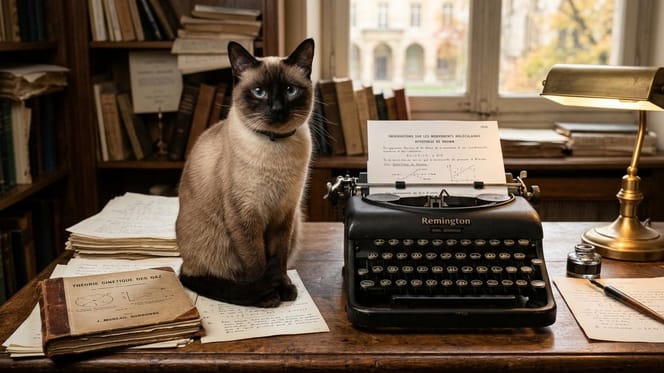

In 1975, Jack Hetherington, a brilliant researcher at Michigan State University, had just finished a major study on the quantum behaviour of helium-3 at extremely low temperatures. He was preparing to submit his paper to the prestigious journal Physical Review Letters. But at the very last minute, a colleague pointed out an unexpected problem: the physicist had written the entire text using the pronoun "we".
Back then, the journal had a strict rule: "we" was strictly reserved for work written by multiple authors. However, Jack Hetherington was the sole author of this study.
A clever trick to avoid days of extra work
In those bygone days, computer word processors did not exist yet. Changing every "we" to "I" across an entire manuscript typed on a typewriter would have taken days of tedious retyping. Unwilling to waste precious time on a minor formatting detail, the scientist came up with a solution that was both economical and full of humour.
As reported by Science & Vie, Jack Hetherington decided to add a second author at the top of his publication. For this mysterious partner, he simply chose Chester, his gorgeous Siamese cat.
To make the name sound credible to the editors, the researcher officially renamed his four-legged companion F.D.C. Willard. "F.D.C." stood for Felis Domesticus Chester, while "Willard" was a nod to the cat's father.
A cat who became a true academic legend
The trick went completely unnoticed upon publication, and the study was a huge hit among physicists around the world. Everything changed, though, when a visiting scientist at the university asked to meet the famous F.D.C. Willard. Jack Hetherington had to confess the truth: his brilliant colleague was actually a Siamese moggy who spent his days purring quietly in the warmth under the radiators.
Far from taking offence, the scientific community was thoroughly amused by the harmless prank. A few years later, the clever feline even published a second article on his own in a specialist magazine. Nearly fifty years on, the original study is still cited in scientific bibliographies, and dear F.D.C. Willard remains forever the most learned cat in the history of physics.
Article generated and translated by artificial intelligence from the FR Wamiz website and reviewed by our editorial team

