
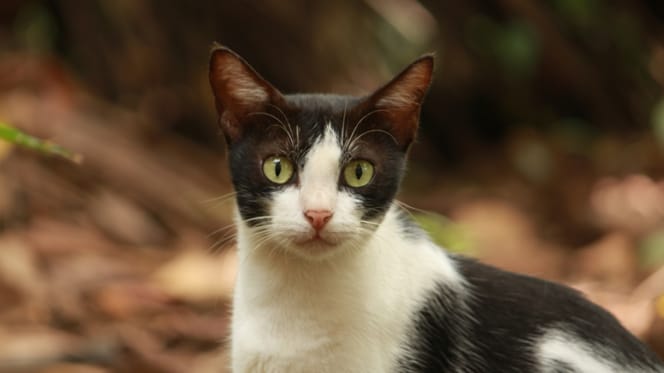

Cats have a well-established reputation for being independent, or even a little aloof. However, if you struggle to connect with your four-legged companion, the problem might not be them, but your communication style. A scientific study has revealed that a very simple technique can send them a universal signal of love.

The “cat smile”: it is all about the eyelids
To communicate effectively with a feline, forget the toothy human smile. Researchers from the University of Sussex have confirmed that to smile at a cat, you need to use your eyes by narrowing them and blinking slowly.
This expression, characterised by partially closed eyes, is frequently adopted by cats when they are relaxed and fully content. It is actually the equivalent of our smile. Cat lovers already suspected that mimicking this behaviour showed friendly intent, but science has finally been able to prove it experimentally.
Two experiments with fascinating results
To test this theory, a team of psychologists set up two rounds of trials, with the results published in the journal Scientific Reports:
The home test: The first experiment involved 21 cats from 14 different households. Once the cat was settled comfortably at home, their owner had to sit about three feet away and blink slowly as soon as the animal looked at them. Cameras proved that the cats were far more likely to blink back after receiving this signal from their human.
The stranger test: The second experiment involved 24 cats from eight households. This time, it was not the owners but researchers (whom the cats did not know) who blinked slowly, while reaching out a hand towards the animal. Not only did the cats respond with the same eye movement, but they were also much more willing to approach the stranger’s hand.
In contrast, when humans stared continuously at the cats without blinking, the felines remained wary.

How to start the conversation
Professor Karen McComb, a psychologist at the University of Sussex and leader of the study, encourages everyone to try this gesture in their daily lives:
“It is something you can try yourself with your own cat at home, or with cats you meet in the street. Narrow your eyes as you would in a relaxed smile, then close them for two or three seconds. You will find they respond in the same way, starting a conversation of sorts.”
Cats turn out to be much more connected to their humans than we think. Further studies indicate that they tend to copy their owners’ personality traits, sense their sadness, and recognise their names perfectly (even if they deliberately choose to ignore them most of the time).
The slow blink is perceived as a peaceful signal. In the feline world, a prolonged stare is seen as a threat or a challenge. Lowering your eyelids shows that your intentions are friendly. According to Tasmin Humphrey, also a psychologist and co-author of the study, this discovery could greatly improve animal welfare, particularly for assessing cat stress in complex environments such as rescue centres or veterinary clinics.
Translated from the FR Wamiz website using artificial intelligence

