
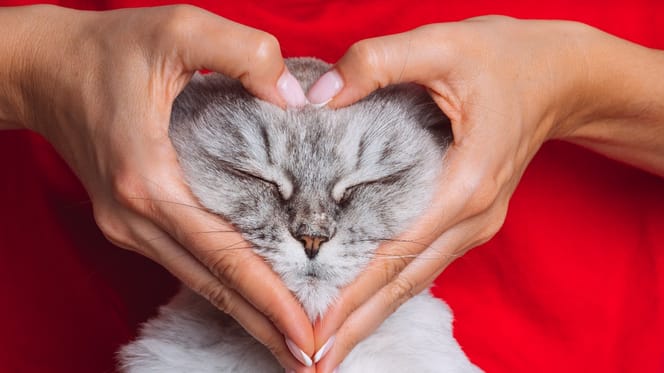

Recent research into feline behaviour shows that cats form genuine, deep bonds with their owners.
Here are the scientific signs that prove your cat really does love you.


1. The slow blink (the feline "smile")
What the science says: A 2020 study by the University of Sussex, led by Dr Karen McComb, showed that slow blinking is the ultimate positive communication signal for cats.
The behavioural explanation: Narrowing their eyes while looking at a human shows that a cat doesn't perceive any threat and is feeling completely relaxed. The study proved that cats are much more likely to approach a human who blinks slowly back at them.
2. Head-butting and cheek rubbing (bunting)
What the science says: This behaviour is well-documented by feline behaviour specialists, including Dr John Bradshaw from the University of Bristol.
The behavioural explanation: Cats have scent glands on their temples, cheeks and chin that release calming pheromones. When they rub against your legs or face, they aren't just "marking their territory"—they are creating a familiar group scent. It is a clear sign that they fully accept you into their safe social circle.

3. A vertical tail (with a slight curve)
What the science says: Feline behaviourist Cameron-Beaumont has analysed cat tail postures in detail as indicators of social intentions.
The behavioural explanation: A high, straight tail, sometimes with a slight curve at the tip (like a question mark), is the universal visual signal for a friendly greeting. This is the posture cats use to greet someone they like and want to interact with.
4. Choosing to sleep close to you
What the science says: Sleep is when a cat is at its most vulnerable. Where they choose to rest is decided by strict safety criteria.
The behavioural explanation: A cat choosing to sleep on you, at your feet, or in the same room is looking for more than just body warmth. In animal behaviour, sharing a sleeping space shows that they see you as a comforting figure and feel completely safe in your presence.
5. Secure attachment
What the science says: A major study from Oregon State University (led by Dr Kristyn Vitale in 2019) adapted the "Strange Situation Test"—normally used for children and dogs—for cats.
The behavioural explanation: The study revealed that 64% of cats develop a "secure attachment" to their owner. This means your mere presence lowers their stress levels in an unfamiliar environment and gives them the confidence to explore. You act as their emotional safety net.
6. Kneading or "making biscuits"
What the science says: This is a neotenous behaviour, meaning a juvenile habit that is kept into adulthood.
The behavioural explanation: Originally, kittens knead their mother's teat to stimulate milk flow, which releases endorphins and oxytocin. In adulthood, cats repeat this motion on soft surfaces or on their human companion when they feel extremely happy, relaxed and loved—just like they did with their mother.
The key takeaway
A cat's affection isn't measured by how much they meow or fuss, but by the quality and trust in your relationship. A cat who seeks out your company, greets you with a high tail, and relaxes by your side is scientifically showing you just how much they love you.
Translated from the FR Wamiz website using artificial intelligence

