
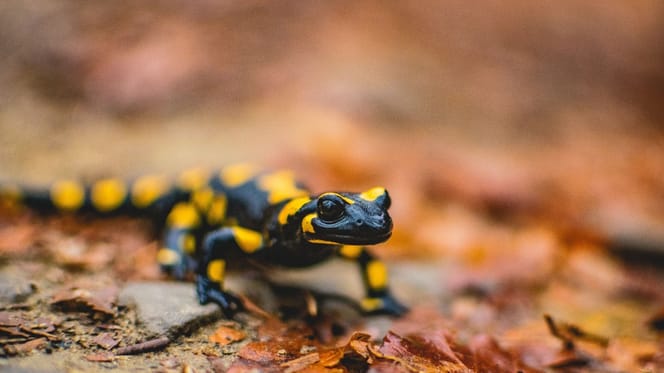


A walk that turned into a tragedy
During a walk in Burgenland, Austria, a one-year-old English Springer Spaniel was sniffing through leaves in the woods when he suddenly suffered seizures. His agony lasted around 15 minutes before he died. Shortly afterwards, his owners discovered a dead fire salamander right where the dog had been sniffing. The post-mortem report confirmed that the dog came into contact with the amphibian's poison just by bringing his nose close to it, reports Kronen Zeitung. According to the newspaper, up to 30 dogs die every year in Austria after encounters with fire salamanders.
A poison especially dangerous for smaller dogs
When threatened, glands in the amphibian's skin secrete a milky fluid containing samandarin, a neurotoxic steroidal alkaloid. In humans, this fluid only causes an unpleasant burning sensation on the skin and, in rare cases, nausea. However, it is toxic to animals, according to WWF Basel.
"For smaller dogs, this can already be problematic," toxic animal expert and vet Nils Kley explained to Der Standard. The danger increases if a dog picks up the salamander in its mouth or bites it, as it comes into contact with much more poison.

Warning signs to look out for
Owners do not always know where their dogs are putting their noses. After coming into contact with fire salamander poison, the following symptoms can appear, according to Bild:
- drooling;
- retching or vomiting;
- tremors and seizures;
- an unsteady gait;
- weakness;
- altered consciousness;
- breathing difficulties.
If you notice any of these signs, you must call a vet immediately.
What to do if your dog gets hold of a salamander
Separate your dog and the amphibian straight away, but do not use your bare hands. This is for your own protection as well as the salamander's, whose skin is protected by a layer of mucus. Touching the creature with dry hands can damage this protective layer, explains Nils Kley. It is best to move the salamander without touching it directly, using a suitable container or damp disposable gloves. If you do not have those, using a piece of cloth will do.
What about the Alpine salamander?
In Switzerland, you can also find the Alpine salamander (Salamandra atra). According to the toxicology database at the University of Zurich (Vetpharm), its secretions also contain toxic steroidal alkaloids, but in smaller amounts: four to five milligrams per animal, compared to 17 to 24 milligrams for the fire salamander.
Translated from the FR Wamiz website using artificial intelligence

