
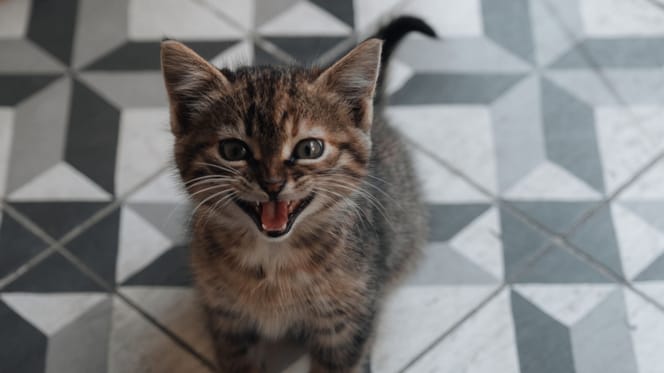

Bad news for cat owners: your companion might have a few complaints about the quality of your service. Their meows, cries, and persistent calls are not just to express annoyance. They are also very deliberately aimed at getting your attention so you fix the problem.
If you had not noticed, that is hardly surprising. Humans are well known for struggling to understand what their felines are trying to tell them. But a new study confirms it: officially, you are your cat's emergency repair service.
A meow tailored for humans
Cats have a varied and often subtle repertoire of communication. Yet one of their tools seems to have been designed for far less perceptive listeners: us. We are talking about the meow.
We have known for decades that cats meow often, and sometimes loudly, around humans, whereas they rarely do so with each other. Feral cats actually meow far less than house cats, showing that this behaviour is clearly linked to being close to humans.
Scientists already suspected that meowing was meant to make us act, perhaps even with different meows to ask for food, strokes, or an open door. The challenge was telling the difference between a cat complaining out of simple irritation and one calling their butler to sort things out.
An impossible treat to reach
That is where Naila Fukimoto, from the University of São Paulo in Brazil, and her team step in... with their treats. The researchers recruited 38 cats whose owners reported plenty of meowing whenever food was involved.
Each cat was then faced with a problem they could not solve alone: their favourite treat was locked inside a small plastic box with holes. The cat could smell it. They knew it was there. But they could not get to it themselves, because they lacked a tool only humans have: opposable thumbs.
The team observed each cat for a minute in two different scenarios: with an attentive human present, or alone in the room.

Sixteen times more likely to meow
The results were clear. When a human was there to hear their complaints, the cats became much more chatty: 86 meows were recorded in total, compared to just 20 when they were alone — about four times as many. Statistical analysis shows that the likelihood of meowing was more than 16 times higher when a human was in the room.
"These results are consistent with a communicative role for meowing in cat-human interactions," wrote the researchers in their paper, published in the journal Animal Behaviour.
And it really was their problem the cats were complaining about. As they meowed, they often stared at the human with big clear eyes, sometimes looking back and forth between their potential saviour and the treat box. It is hard not to see that as a plea to put an end to this unacceptable situation.
When nobody was there, however, the cat spent more time sitting still, looking at the door. In other words, cats were not just complaining about the unfairness of life: they adapted their behaviour depending on who was around to fix it.
Findings to keep in perspective
This does not necessarily mean cats realised their human could solve the problem, nor that every meow was a deliberate request. But meowing appears to be much more than an involuntary reaction to feline emotions. According to the researchers, most meows were addressed to someone: cats were not vocalising into thin air, they were aiming at a specific audience.
The study does have its limitations. It focused on a small number of animals, and researchers deliberately picked cats already known for being vocal about food. So the results might not apply quite as well to cats that prefer to suffer their misfortunes in silence.
Future studies could analyse the meows themselves and compare them to those made in other situations, to see if cats use different sounds depending on what they want. But for anyone sharing their daily life with one of these furry little divas, these conclusions will hardly come as a surprise.
Translated from the FR Wamiz website using artificial intelligence

