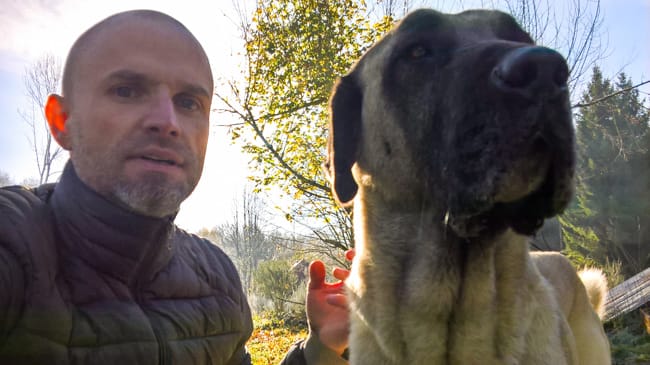
I rescued an Anatolian Shepherd from a local rescue centre two days ago.
On walks, he wants to choose which way we go, and if I pick a different direction (which I obviously do just out of principle), he just plants himself and refuses to move forward or—even worse—turn back.
I’ve tried to snap him out of it and distract him, but it's no use; he’s completely fixated on being stubborn.
The issue is, given his size and temperament, brute force isn’t going to work. This has happened several times now and it’s getting worse.
The worry is that if things continue like this, I won't be able to keep him. If I can't walk him, I'd be forced to keep him tethered, and that would cause other issues, not to mention that I'm really not happy with that idea!
So, if anyone with the right expertise or experience could give me some pointers?
At the moment, the only workaround I have is to tie him up where he is, go and get the car, come back for him, and drive home. But sooner or later he’s going to clock on, and I probably won’t even be able to get him into the car in that situation...
Thanks in advance for your help.
Translated from French
The forum content is sometimes translated from another language, and posts may concern countries with different animal laws. Do your research before making any decisions.
Since the forum is translated by AI, the translations may contain errors.
It’s definitely a problem, but in my opinion, you’ll manage to train your dog without too much trouble. First and foremost, I think you need to build a strong bond with him so he’s really attached to you and follows your lead when you're out and about. Try working with a long lead and a check chain (not a prong collar, mind). These chains make a clicking noise that catches a dog’s attention and helps them feel the correction better. You could put it on him for a walk, and if he starts doing that, give him a sharp tug straight away (a very quick movement, but obviously don't snap his neck!). That should get a reaction and get him moving. Is there a specific reason why he does it though? Something new? Another dog? A noise in the distance? Seeing a professional trainer would also be a massive help if you can afford it.
Good luck!
I just wanted to share my two pence as I’ve tested a head collar and now use an Animalin harness. 🙂
A head collar doesn't really seem suitable in your case. Your dog is a big, strong lad, but if it turns into a battle of wills, even if he’s stronger than you, you could end up seriously injuring his neck (and if he ends up paralysed, you’ll have an even harder time getting him to move! 🙄). Besides, those are mainly for dogs that pull on the lead, not for dogs that refuse to follow (the lead wouldn't be pulling in the right direction, so it wouldn't be very effective). And honestly, trying to win a dog's trust by causing him pain doesn't seem like the right way to go about it. :p
The Animalin harness helps me because my dog tends to pull on the lead (not all the time, mostly at the start of a walk when he’s desperate to sniff the whole world, or when we pass other dogs or he sees cats bolting XD). In those situations, it’s much easier to hold him back as it changes the leverage a bit. It also helps me teach him to walk on a loose lead thanks to the front-attachment point (which is what this harness is actually designed for). I also really like the handle on the top, which can be very handy. 🙂 But while it’s a great bit of kit, I don't see it as the solution to your specific problem.
Since your issue isn't that your dog pulls, but rather that he refuses to follow you, I agree with the advice about building a bond with him. You need to help him understand that just because he’s following you, it doesn't mean it won't be fun or that the walk is over. Do plenty of work at home, putting his lead on and everything, using treats or something else (if he has a favourite toy or a game he loves more than treats, use that as an incentive to get him moving your way). Do this outside as well once he’s more responsive (which should happen eventually). Bit by bit, he’ll get used to you and realise that walks with you are great, even if he has to follow your lead instead of just going wherever he fancies.
On that note, try going in his direction sometimes too. Let him "win" every now and then so he sees you aren't always just saying "no" to what he wants. It might mean a bit of a detour, but if it’s only occasionally and it helps him follow you better afterwards, it’s worth a go. 😉
Don't forget that you haven't had him very long and he’s come with quite a bit of history. It’ll take a bit of time for him to get used to you, and for you to understand how his mind works.
If you’re really struggling, you could also try asking a dog trainer or a behaviourist. They might be able to spot some things to help you that you haven't noticed yet.
The main hurdle right now is your dog’s self-determination. He’s determined to do something other than what you want him to do. You’re the newcomer in his life, someone he doesn't know yet and with whom (unfortunately) he hasn't built a bond of trust, and you're asking him for something. He has his own history, he’s learned to rely on himself rather than others, and he has his own ideas about how things should go.
Two things:
1. In time, he’ll learn to love you, look up to you, and follow your lead, but that won’t happen overnight.
2. You still need to learn how to manage that strong-willed nature, especially by teaching him the meaning of the word ‘No’.
Here’s a simple little example of a session where I have a bit of fun working through my Shiba Inu’s stubbornness:
At one point, I’m practising saying no to her. I’m expecting her to do a perfect "Relax"—which means lying on her side—and I’m using a simple "No" to block her access to some very smelly sardines. This activity helps establish a healthy bond between the owner and the dog, where the dog is able to grasp some fundamental things:
1. You’re the one in charge, not him
2. If he does things right, he can trust you; he’ll always be rewarded
I’ll finish by reminding you of the basics of positive reinforcement. Never go out without a few treats to reward your dog. As soon as he agrees to change direction, make a real fuss of him. He needs to understand that you LOVE it when he changes direction. That’s how he’ll learn to love you, become your partner in crime, and all that.
And if you don’t like the gentle approach, well, put a headcollar on him and don’t give him a choice. Pull, let him growl and grumble, keep pulling, and take him where you want. Let's just say it’s another way of expressing your leadership. Personally, I’d be hesitant to do that, as you don’t really have a connection or a relationship yet.
I don't think this issue is impossible to fix at all, but I hope you can see some improvement in the trend soon before you lose your patience. Otherwise, I should mention right away that there is the 'tough love' approach—direct confrontation—which gets results, particularly with the famous and incredibly effective Cesar Millan.
Let me start with that point first, as it could be the difference between keeping your dog and sending him back. He’s well-known, misunderstood, and heavily criticised—wrongly, in my view. Regardless, it happens; it's documented in one of his episodes. Oh yes, there’s the one with a tiny dog that systematically refuses to walk. He just plonks himself on the ground and his owner was dragging him along. Cesar used the firm approach with him.
In your case, that would involve using a headcollar and struggling to go in the direction of your choice. The dog will obviously grumble and put up a fight. At the end of this struggle, which can last a fair while, he’ll calm down, understand, and resign himself to walking.
Mind you, that wouldn't be my first choice for you, especially if you have plenty of free time to work through this difficult patch.
Let’s look at the standard theory. If you search on YouTube, most clips showing you how to get around this hurdle suggest the same thing:
When you want to go in a different direction and the dog refuses to follow, you stop. You stay rooted to the spot until he gives in and goes your way. Then, you give him a reward!
Which brings me to the important subject of treats. If I had a problem dog, believe me, he wouldn't get any free food. He’d have to earn every single mouthful he gets from me. So, at home, I’d teach and practise the basic skills for a good walk.
This leads me to those skills, and my own approach to walking. I chose to teach my dog keywords—commands—to manage the walk. She knows "Walk on" (meaning "let's go" or "speed up"), she knows "Stop", she knows "Steady", and I use Cesar’s "Tschht" sound to give her even more direction. I taught her all of that at home; we practised in the house, then in very quiet spots, and finally out on the street. That's how I built up her heel work and lead walking. It’s only very recently that I bought a bit of kit that makes walking to heel even easier.
Which brings me to equipment. There are two items I think could help you:
1. A headcollar, given the size of your dog. This tool gives you the most control over his head.
2. An Animalin harness.
Why an Animalin? Because it has two attachment points, including one on the chest. That attachment point is designed to stop the dog from pulling on the lead.
I’ve never seen a dog that could resist a treat. If I may say so without wanting to be hurtful, I get the impression you’re admitting defeat before you’ve even started. You seem convinced it won’t work, but you’ve got to give it a go.
I adopted a Boxer who weighed 50kg (nearly 8 stone, or about 110 lbs) – he must have had something else in his bloodline besides Boxer. We were the 17th people to take him in. He used to bolt, wreck the house, and try to bite. When he first arrived, he smashed a broom and a chair by lunging at them; he’d been beaten with them, you see. Believe me, it took time and patience, but he understood right away that I wasn't going to be a pushover. At the same time, I was giving him a chance, and it was his last one – if I hadn't kept him, it would have been the end of the line for him. It taught me to observe and analyse his behaviour and find "remedies".
Try teaching him to walk to heel and basic commands in your garden, and if you can, at a training club. It’ll really help you out.
At the beginning, you said the problem was manageable, so if it’s worse now, it’s because he’s got the upper hand. You say he wants long walks – well, who doesn’t? Neither I nor my dogs can get enough of them; walks are pure bliss for them. It’s also natural that he wants to call the shots – they all try it on! It’s up to us not to let them get away with it by being a bit savvy and using a firm voice, but absolutely without hitting them.
Keep your chin up and let us know how you get on.
1- Yes, I knew about it before I got him, but the issue was manageable.
2- I’ll give it a go just for peace of mind, but he’s really not the type of dog to fall for that kind of trick.
He wants long walks and wants to decide where he’s going.
He’s a dog that had run away several times (the reason given for him being given up), so he’s definitely used to just heading off and doing his own thing. He’d also been through several owners before ending up at the RSPCA, which has probably reinforced his independent streak. Or at least the impression he gives of one.
How old is he?? Did the rescue centre warn you about this problem?? Are they even aware of it???
Have you tried, when he heads off in another direction, making him sit and stay for 3 or 4 minutes without moving to see what he does? Has he seen something that interests him, or is he just as stubborn as a mule? You have to realise that you won't get anywhere with him by using force, so you need to be a bit cunning. Keep some dog treats in your pocket; when he wants to go elsewhere, get him to sit and stay, give him a reward, then move slightly to the left – treat, then to the right – treat, turn around – treat. And then, why not go where he wanted to go to see what it was that interested him so much? Get into the habit on your walks of stopping, doing quarter turns to the left and right, and U-turns, always with a treat and a "yes, good boy", a pat on the shoulder, "good boy" – really make a fuss of him. You could also keep a squeaky ball in your pocket and give it a squeeze; that might distract him for a couple of seconds, just long enough for him to forget why he wanted to go in a different direction. You've chosen a big dog, and walking them is more of a challenge than walking a Yorkie, so use treats and a bit of trickery – you have to be ingenious to outsmart him. Keep us posted.