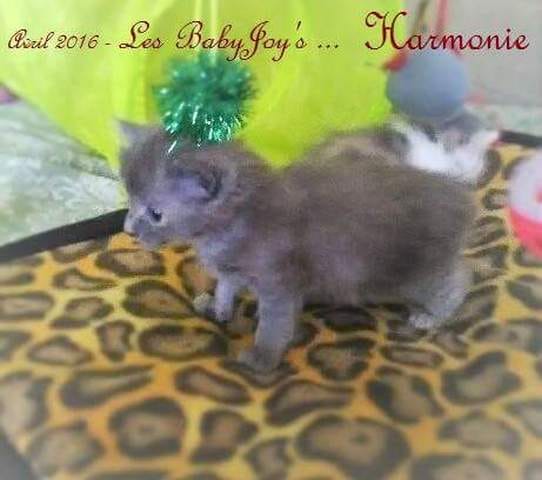
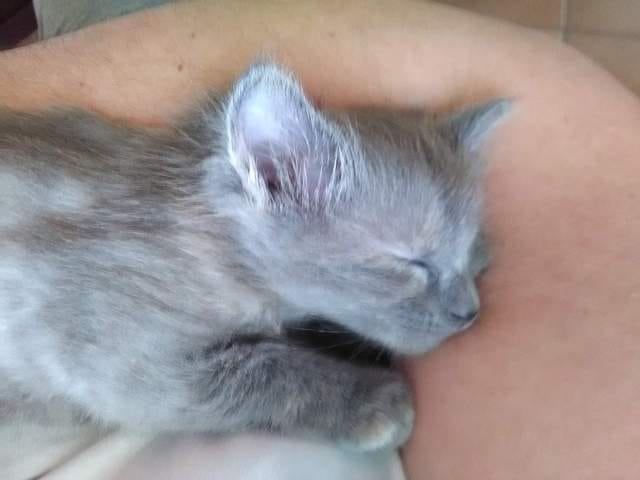
I'm brand new to the forum and I've taken in a pregnant cat who has had three kittens. In the litter, there's our baby Harmonie, whom we're keeping, and I'm wondering what her coat will be like.
It's longer than her brother's and sister's. Could you please tell me if she's likely to be long or short-haired?
Thanks.
Translated from French
The forum content is sometimes translated from another language, and posts may concern countries with different animal laws. Do your research before making any decisions.
Since the forum is translated by AI, the translations may contain errors.
Too early to tell, you'll have to wait another month or two yet. It’s definitely not long-haired, but she could be semi-long or short-haired with a softer, lighter texture than the others. It’ll be a surprise as she grows up.
Hello,
Thanks for your reply.
I just wanted to see if it was possible to tell yet, mostly out of curiosity 😉
Her coat isn't really a priority for me; the main thing is that my little one is doing well. Long hair or short hair, Harmonie will always be my precious baby.
Hello,
Thanks for those really interesting and well-explained details. I don't know who Harmonie’s dad is, but Joy, her mum, is a short-haired calico. I took her in as a stray when she was pregnant.
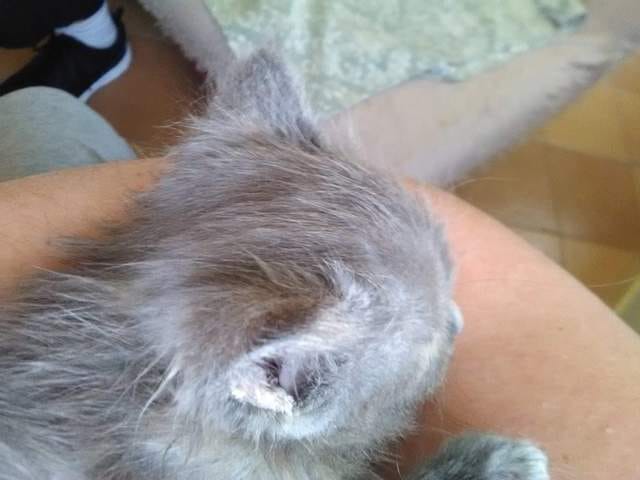
The thing is, Harmonie has little tufts on the tips of her ears and bits of fur sticking out from between her paws. Her coat is so thick that I can actually "style" it—I can brush the fur in whichever direction I want. Her coat is much longer than her brother’s or sister’s.
I’ve also got a question (since you clearly know your stuff regarding advice for kittens). It’s nothing to do with the coat issue, but they used to use the litter tray, and for the last two days, they’ve stopped completely and are going on the floor instead. I’m not sure if this is normal or how their training should be going. Are they still too small to really understand what the tray is for? They were born on the 7th of March 2016.
If you have any tips, I’d love to hear them.
Kind regards
It’s too early to tell just yet; you’ll have to wait another month or two.
She’s definitely not going to be long-haired, but she could be semi-long or short-haired with a softer, lighter texture than the others. It’ll be a surprise as she grows up.
Hello,
Kittens keep their "baby coat" until they are about 2 months old; they then shed it between 3 and 6 months. This is when you can definitively identify whether a cat is long-haired or short-haired. In reality, only the Persian is considered truly "long-haired". Other cats with longer coats are classed as "semi-long-haired", though this doesn't really change how difficult it is to tell early on.
In practice, to get a better idea of a kitten's future coat, some people look inside the ears; if there are long, thick tufts of hair, there is a good chance the kitten will be semi-long-haired.
Lastly, a bit of the theory behind it. Coat length is determined by a gene. The long-hair gene is recessive, meaning it must be carried by both of Harmonie’s parents. It all depends on whether the mother has any long-haired ancestors. If she doesn't, the short-hair gene will be dominant, even if the father is long-haired.
To help you understand:
long hair = recessive gene = ll (homozygous)
short hair = dominant gene = LL (homozygous) or Ll (heterozygous, meaning they carry the long-hair gene)
Case 1
LL x ll --> all kittens will be heterozygous short-haired (Ll) but will carry the long-hair gene. This means they could produce long-haired offspring if bred with a long-haired cat or a heterozygous short-haired cat (see cases 2 and 3).
Case 2
Ll x ll --> 50% chance of long-haired kittens (ll) and 50% chance of heterozygous short-haired kittens (Ll).
Case 3
Ll x Ll --> 25% chance of a long-haired kitten (ll) and 75% chance of a short-haired kitten (with a 1 in 3 chance of it being homozygous (LL) and a 2 in 3 chance of it being heterozygous (Ll), thus carrying the long-hair gene).
Case 4
Ll x LL --> all kittens will be short-haired, with 50% being homozygous short-haired (LL) and 50% being heterozygous short-haired (Ll), carrying the long-hair gene.
Case 5
ll x ll --> all kittens will be long-haired (ll).
Case 6
LL x LL --> all kittens will be homozygous short-haired. If these kittens are bred with any cat (short or long-haired) once they are adults, they will only ever produce short-haired kittens.
I hope this helps,
Lauranne – Vet student at the Alfort National Veterinary School (EnvA)
Project Manager for ProVéto Junior Conseil, the EnvA Junior Consultancy http://proveto.net/