My two female dogs are fighting till they draw blood due to jealousy – is there any solution?

J
Joychica Icon representing the flag French
Report

Hi everyone,

I’ve got a problem that seems impossible to fix based on what I’ve been reading.

I have two female dogs: a 4-year-old working-line Belgian Tervuren and a 5-year-old Jack Russell cross. They’ve started fighting quite violently over the last few months, to the point where I had to take my Jack Russell to the vet to get stitches.

The reason they’re fighting is US. My Tervuren is incredibly affectionate with everyone and is the biggest ‘Velcro dog’ I’ve ever seen. She’s always been quite possessive, but now she can’t stand the Jack Russell coming near us, even in the garden. It’s reached the point where I avoid stroking the Jack Russell just so I don't trigger a conflict. If only the Jack Russell would submit, but on the contrary, she stands her ground and attacks the Tervuren back – even though the Tervuren is about five times her weight. It’s not easy to separate them, and my husband is worried that we or the children might get bitten while trying to break them up or by just being in the wrong place at the wrong time.

You should know that we took the Tervuren in when she was 6 months old. She went through a deep depression after being abandoned and it took her several weeks to recover.

My husband changed jobs a while ago and is home less often now, so the Tervuren is getting less attention than she used to. This might partly explain why her possessive and nervous behaviour has worsened (she even chatters her teeth with excitement).

My question is: I’ve read that once the ‘war’ has started, they’ll never stop fighting. Is there any other solution besides keeping them constantly separated when we’re home (they don’t fight when we’re out), or having to rehome one of them to prevent it ending in an irreversible bloodbath?

Translated from French
icon info

The forum content is sometimes translated from another language, and posts may concern countries with different animal laws. Do your research before making any decisions.

Since the forum is translated by AI, the translations may contain errors.

Loading editor

Write your message and upload a photo if you want to! Please remain courteous in your exchanges.

Your post will be visible to all members of the international Wamiz forum.

30 answers
Sort by:
  • Show previous comments
  • Merline
    Merline Icon representing the flag French
    Report

    often, two dogs of the same sex just don't get on after a certain point

    Seriously? 🤪🤷

    We've always had at least two males for a good few years now, even three back when our good old Lab was still with us... and never any trouble (except for right now, a few tiffs because the Cocker has been a bit "grumbly" since that incident) but otherwise they're pretty... cuddly, they're just best mates really ^^

    Translated from French
    Tania28
    Tania28 Icon representing the flag French
    Report
    Neutering can definitely help, provided it’s done before the hormones kick in, so I’m a bit doubtful in this case given their age; but you never know! It’s another expense to consider, though.
    Translated from French
    Tania28
    Tania28 Icon representing the flag French
    Report

    A behaviourist will assess how the girls are acting (it’s actually very common for two dogs of the same sex to stop getting along at some point) and give you some pointers. They’ll also look at how you’re interacting with them; there might just be a little oversight that you'll be able to sort out yourself.

    You can't go on living like this—for the sake of your family and the dogs themselves.

    Translated from French
    Energiesolaire
    Energiesolaire Icon representing the flag French
    Report
    From what I’ve read on other forums, getting them spayed could also be the first step towards a solution. Getting both females spayed is an absolute must, as in a significant number of cases, coming into heat triggers fights. This is really important. You mentioned that one of them is ill. Whenever a dog living in a multi-pet household has to undergo a "procedure" or take medication that might affect their state of mind, they can lash out at any member of the family, though it’s more common to see dog-on-dog aggression.
    Translated from French
    Energiesolaire
    Energiesolaire Icon representing the flag French
    Report
    I don’t really have much faith in a behaviourist who isn’t aligned with the veterinary behaviourist profession, mind you. So, if you want some proper support with this one, you’re best off finding a veterinary behaviourist.
    Translated from French
    Energiesolaire
    Energiesolaire Icon representing the flag French
    Report

    By the way, the offer still stands for anyone interested in this – you’ll be the testers.

    Mind you, there’s about 15,000 words of documentation to read, but it’s a pretty easy read.

    Translated from French
    Energiesolaire
    Energiesolaire Icon representing the flag French
    Report
    If you want to sort this out, PM me your email address. I’ll give you access to my web portal; I’ve got a full guide on the issue. You’ll have plenty of reading to do—it should take you about 4 to 5 hours—and then we can see what can be done, okay? At the moment, your dogs hate each other, so they mustn't be left together. If you feel you need to act urgently, send me your email quickly so you can get through the material as soon as possible. These situations can be resolved, but there’s very little room for error.
    Translated from French
    Merline
    Merline Icon representing the flag French
    Report

    Otherwise, this is what the damage looks like, even 9 years on…
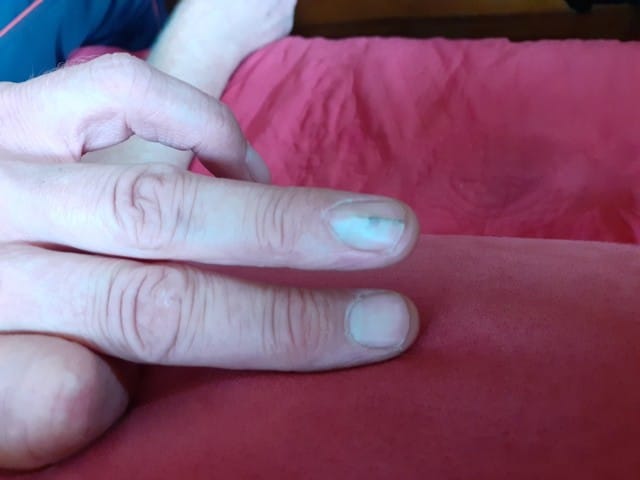
    This is my husband’s finger after his hand was mangled having to separate our Cocker Spaniel and a German Shorthaired Pointer we’d taken in for the umpteenth time (he’d been abandoned! The local rescue was full, so we kept him with their blessing, of course).

    At that point, we went from 3 to 4 dogs!

    I saw what was wrong STRAIGHT AWAY, but with the Cocker already an adult and the Pointer too, both with their own different histories... there wasn't much we could do because the Pointer completely ignored the Cocker's "seniority" (he was smaller, sure, but he was there FIRST).

    We corrected him EVERY TIME, but there was ONE time too many over the food bowl... the Pointer grabbed the Cocker by the throat and wouldn't let go... Blood EVERYWHERE!!!

    I was holding the Cocker on one side, my husband was trying to pull the Pointer off on the other, and by putting his hand between their mouths: BANG. Hospital for my husband and the emergency vets for the dog... the Pointer didn't have a scratch on him, just red mist in his eyes and ready to go again...

    Phew... we tend to rescue dogs "within the family", so he was able to go and live with my in-laws.

    Where he lived happily until a fortnight ago (I'll do a separate post on that: HE FELL INTO A DRAINAGE HOLE COVERED BY LONG GRASS!!!)

    So thank goodness we had a Plan B, because every single day, that tension in the house... Brrrr!!!

    After that, the Labrador and the Mastiff treated him with total contempt (don't even get me started on the Cocker!)... you’d have the Pointer on one side and the other 3 in another room, and at the slightest eye contact, there was growling coming from all directions...

    The atmosphere in the house... Wow.

    Same during walks: Pointer on the left, the other 3 on the right in "we hate you" mode... and if we tried playing together, like going for a ball in a big open field, it’d start ALL OVER AGAIN the moment they reached the ball, not to mention the non-stop grumbling during the walks... it was a nightmare.

    If it hadn't been for my in-laws, we would have called in a behaviourist, but things were already looking pretty bad from the start and, above all... it was the "whole pack" that would have needed sorting out. But we would’ve done it, for sure... we’ve NEVER taken a dog back to the rescue.

    I think you REALLY need a pro to spend some time at home with you and the dogs... seriously.

    Either that, or someone you trust implicitly that you'd feel okay rehoming one of the two with...

    Trying to handle it yourself is going to be a real struggle.

    😞

    Translated from French
    ?
    Anonymous user Icon representing the flag French
    Report

    Hi there,

    Of course, this is definitely something you can work on :-)

    You can start by having a look at this video, which gives you an idea of possessive dynamics and managing interactions (https://youtu.be/0m22Dt_uQuQ)

    Assuming you're comfortable with English, of course! :-)

    The basics: it's the owner who should initiate contact, not the dog. You should never let a dog claim or block access to their owner's space by leaning against them to form a barrier.

    Don't give affection to overexcited dogs, and don't let them crowd people by jumping up, crawling all over them, and so on.

    These are the real fundamentals for managing interactions when you have a group of dogs with a possessive or aggressive individual.

    I once had a foster dog who was an absolute nightmare in this regard; when he first arrived, he was constantly snapping at my own dog, blocking her from the furniture, corners of the house, people... he was like a total psycho!

    But after a week of applying simple rules and a bit of active moderation, the two dogs were able to live together for months without a single hitch (until my foster was rehomed).

    Translated from French
    Kikaah
    Kikaah Icon representing the flag French
    Report
    To start with, you should find a way to let them burn off some energy on a walk in the middle of the day. It’ll help settle the dogs down.
    Translated from French
  • 20 comments out of 30

    See more
  • Do you have a question? An experience to share? Create a post on our forum!