I’m joining this community to ask for some honest advice/opinions :)
So, my little girl Kira, who’s only three and a half, hasn’t been herself these last two days. She was eating less, hiding away in the flat, and most of all, she’d stopped playing (even though she usually wakes me up in the middle of the night when she's playing).
So I went to the vet, feeling quite hopeful, thinking she was probably just a bit run down.
Well, I came away with a diagnosis of Stage 3 or even Stage 4 CKD (kidney failure)!
They put her on a drip for 48 hours; her urea (60 mg/dl) and creatinine levels have come down, and I was able to bring her home today.
But what about her future? She’s got tablets to take every day and specific 'renal' dry food.
Should I expect to only have a few more days with her? A few weeks? A few months? I don’t even dare hope for years.
Does anyone know why it’s happened so fast (because I keep thinking there must have been Stages 1, 2, and 3 before Stage 4) and if I should have spotted it? Isn’t this usually a disease for cats over 10 years old?
Thank you for your replies...
Translated from French
The forum content is sometimes translated from another language, and posts may concern countries with different animal laws. Do your research before making any decisions.
Since the forum is translated by AI, the translations may contain errors.
I made a mistake, the urea is in umol/L, so you’ll need to use this chart (boree.eu/conversion.xls) to convert it into g/L.
For example, from the first blood test, that works out at 68.4 g/L for the urea.
Well, that’s great news, I hope your girl continues to improve!
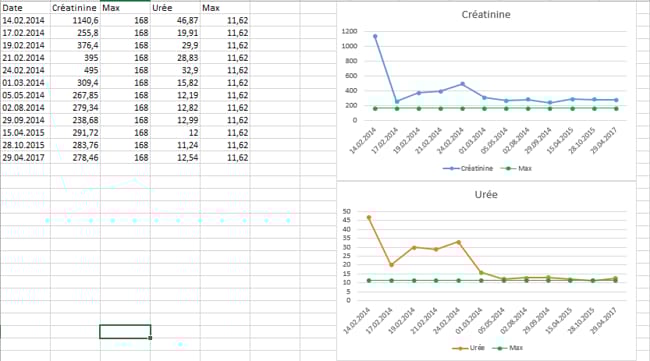
We weren't really told about a specific stage; at first, they told us he wouldn't last two days, but three years later he's still here! His urea and creatinine levels fluctuated between February and May 2014, but they've been stable ever since.
I keep a very close eye on my cat’s illness (probably too close!) — I’ve even made a graph to track his progress 🙄. Since I haven’t had a clear answer regarding the stage of the disease, I’ve attached the graph as an image with the levels in mg/L for creatinine and g/L for urea, if you want to compare. The big drop in the figures was down to the IV drip.
I wanted to share our experience just to say that life expectancy estimates shouldn't be taken as gospel. Since then, we’ve probably been making the most of our cat even more, because we feel that every day really is a 'bonus', but we still hope he has many more lovely years ahead of him, even though we know his condition could take a turn for the worse at any time.
It’s the same for your girl — she could have another year, but why not ten if the condition stabilises!
As for the treatment, we have to take our cat with us or leave him with someone when we go away so he gets his meds every single day. I think being consistent with the medication makes a huge difference to how well it works.
It’s really interesting to read some more positive feedback for a change. However, you didn't mention what stage of the illness your cat was at when they started to pick up?
Mine’s been doing better for a month now. I took her for a check-up a few days ago; I was so stressed because the day before, she’d been sick and was starting to hide away again! But in the end, after checking her creatinine and urea levels, she’s dropped back to Stage 3, which means her life expectancy has gone from 35 days to a year!
As for the medication (Semintra), it’s much easier now because it’s an oral syringe, so it’s done in two seconds. Mind you, I’m still wondering how I’ll manage to give it to her when I go on holiday... I’ve got a friend coming round to look after her, but only every other day...
Long version: Back in February 2014, I decided to take our cat to the vet. He seemed to be losing weight, was sleeping all the time, becoming a bit of a fussy eater, and had started peeing in various spots around the house. Most worrying of all, he was being sick more and more often.
Given all these symptoms, it didn’t take the vet long to reach a diagnosis. After some blood tests, the verdict was in: severe kidney failure. Of course, by the time these symptoms show up, it means the disease is already quite advanced. His urea and creatinine levels were so high that they told us he might not even make it through the weekend.
He was put on a drip anyway to try and save him. There were two possible scenarios: either the failure was due to kidney stones, in which case his levels should drop quickly and things would go back to normal once the stones were cleared, or the levels would drop but remain high, meaning it was CKD (Chronic Kidney Disease).
The next day we got a phone call; his levels were still high but had definitely come down, so they kept him on the drip to see how much further they could get them to drop.
After a week in the animal hospital, we finally brought him home. His levels seemed stable but were still a bit above the normal range, so it was confirmed as CKD. This meant a specific diet (for us, it’s Hill’s K/D dry food) and medication for life (Fortekor and Renosan). We had a follow-up blood test scheduled a few days later to make sure things had stabilised.
A few days later, the results of the check-up came back: his levels had gone back up. We’d had a feeling they might, as he’d stopped eating again and had started hiding away in odd corners of the house where he didn’t usually sleep. The vet suggested putting him to sleep, but I refused for the time being, wanting to wait a little longer.
He was very weak at that point; we could feel the end was near and were prepared to book the appointment to end his suffering at any moment. Desperate, we tried everything to get him to eat, but nothing worked—he wouldn’t even touch a tin of tuna (and he used to come running the second he heard a tin opening). We noticed, however, that he was licking the juice, which gave my partner the idea to buy some mousse-style wet food. By licking the mousse, he managed to swallow some and slowly started regaining his strength.
We kept this up for several days, then months, combined with his medication. Bit by bit, he put weight back on and got his strength back, eating a little more every day. Eventually, his appetite fully returned. We were able to start giving him the special dry food for his condition again, and he was happy to eat it.
It’s been three years now and he’s full of beans! He plays, he’s very affectionate, he eats well, and every morning he eagerly waits for his medicine mixed into a bit of wet food!
Anyway, here is our story regarding CKD.
Every case is unique, but I’d still like to share our experience with our cat, who has also been living with CKD since 2014. I want to give some hope to those who, like we were three years ago, are scouring forums for information and comfort. At the time, we would have loved to find some positive stories to give us hope, but instead, we only found stories with tragic endings.
I’ll do two versions: a short one for those who want to get straight to the point, and a long one for those who’d like to know the details.
Short version: Our cat, who was 8 at the time, survived a kidney failure crisis in 2014. He had a week’s stay in hospital on a drip and is now on daily medication (Fortekor and a renal supplement) and a specific diet. I won't lie, you do need the funds: it was over £850 when he was discharged from the clinic for the hospitalisation, and you then have to factor in the cost of lifelong treatment and the special food, which is also quite expensive.
Our cat is 11 now and is doing really well. We’ve had regular blood tests ever since (every 6 months, then every year) to check his urea and creatinine levels. The levels are slightly above the normal range but stable, and he hasn't needed to go back on a drip since 2014. Anything is possible, you have to keep the faith!
(Sorry, I’m doing several posts as the message is too long otherwise)
Regarding the treatment, don’t panic. It’s tricky at first, but then the cat gets used to it and you get the hang of it. Initially, we really struggled to give our cat his tablet, but now it’s a total breeze. We’ve got two medications to give him: a tablet and a capsule that we open up and sprinkle onto a bit of wet food. So we start by popping the tablet down his throat, and he’s good as gold because he knows that afterwards... he gets his wet food! The other medicine gets wolfed down along with the wet food!
Hi everyone,
As promised, I’m getting back to you after the second appointment.
It’s a really good clinic, actually; they take their time and really listen. Kira had some more blood tests (as the previous vet hadn’t checked her phosphorus levels) and an ultrasound.
She’s stabilising, and I have to go back in a month, but the vet told me she’s still at Stage 4, with kidneys that are far too small and are basically failing. She said that, given her age and the state of her kidneys, it’s a congenital issue.
However, she did mention that the average life expectancy is only about 35 days.
I’m going to make the most of our time, spoil her rotten, and take comfort in knowing that she isn’t in any pain...
I'll keep you posted, the appointment is on Wednesday; I'm really looking forward to getting that second opinion.
Yeah, she really is. I live alone, and she was so cuddly with me right from the start—she doesn't leave my side... You get attached so quickly as a result!
I’m all for wetting the capsule, especially as mine is prone to spitting it straight back out; that way the coating gets a bit sticky and stays put. I just dip the capsule in some water and pop it in!
I’m looking forward to hearing back from you, hopefully with some positive news in the short or medium term after your next vet appointment. It would be a good idea to keep going with the hydration treatments, because if her levels drop, it could mean several more months for her, or even longer. If things don't improve, at least you’ll know exactly where you stand regarding end-of-life care.
Your little sweetie looks absolutely adorable...